
What Is an AI Marketing Assistant?
An AI marketing assistant is a person who uses AI tools to run your marketing work: writing content, building email campaigns, scheduling social posts, supporting paid ads, and pulling reports. The AI does the heavy lifting on drafts and data. A skilled human briefs it, edits it, and ties it back to results you can measure.
The phrase gets used two ways, and the difference matters for what you buy. Some companies use "AI marketing assistant" to mean software: an app that writes copy on command. Others mean a person who is fluent in those tools. The software is real and useful, but on its own it does not know your brand, your customers, or what "good" looks like for your business.
That gap is the whole point of this post. AI marketing tools are strong, but a business gets real results when a trained human runs them. You stay the strategist. Your assistant turns the strategy into shipped work, using AI as a multiplier instead of a novelty.
What Does an AI Marketing Assistant Do?
An AI marketing assistant produces and manages the marketing work you do not have time for: content drafts, email sequences, social calendars, ad support, SEO research, and weekly reporting. The AI speeds up each task. The human owns the quality, the brand voice, and the decision about what actually ships to your audience.
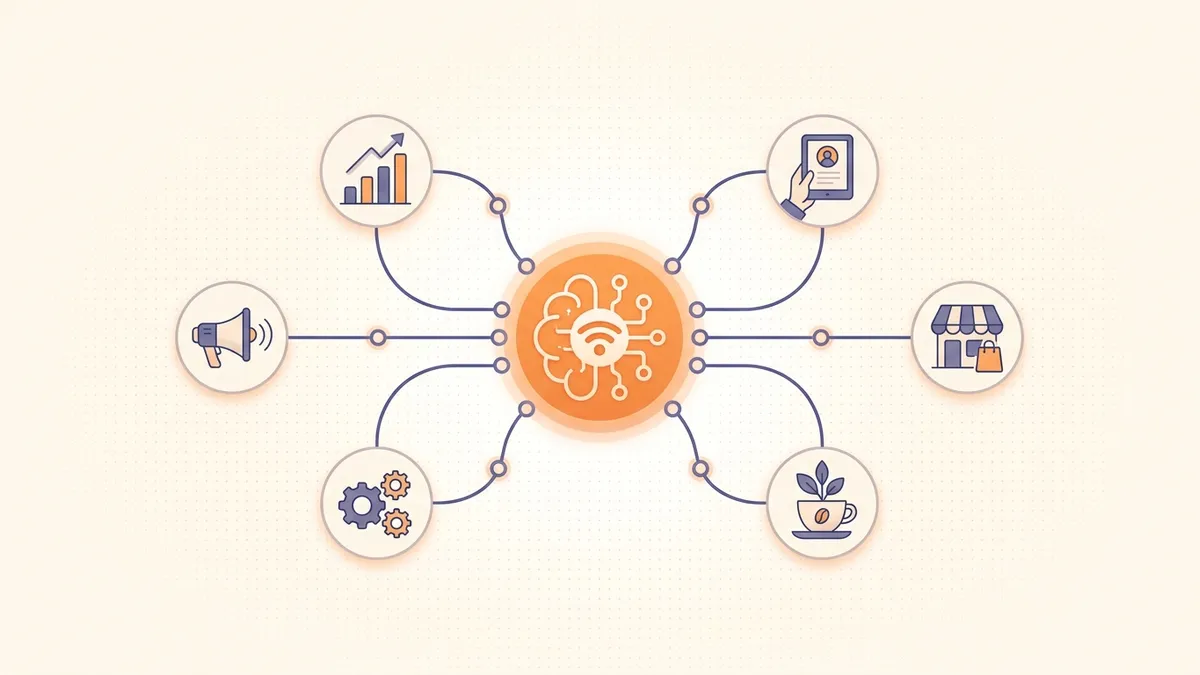
Here is what the work looks like across the main marketing functions, and the kinds of tools an AI-trained assistant reaches for in each one.
| Marketing function | What the assistant does | AI tools they use |
|---|---|---|
| Content and copywriting | Blog drafts, landing pages, product descriptions, refined to your brand voice | ChatGPT, Claude, Jasper, Grammarly |
| Email marketing | Sequence drafts, newsletter builds, subject-line testing, list segmentation | HubSpot, Mailchimp, Klaviyo, ChatGPT |
| Social media | Content calendars, captions, repurposing long-form into posts, scheduling | Buffer, Hootsuite, Canva, CapCut |
| Design and creative | Graphics, ad variations, thumbnails, simple video edits | Canva, Midjourney, Adobe Firefly |
| SEO and research | Keyword lists, competitor teardowns, content briefs, on-page checks | ChatGPT, Surfer, Ahrefs, Semrush |
| Paid ads support | Ad copy variations, audience notes, budget pacing checks, creative testing | Meta Ads, Google Ads, ChatGPT |
| Automation | Connecting your CRM, email, and forms so leads and data move on their own | Zapier, Make, HubSpot workflows |
| Reporting | Weekly performance summaries, dashboard prep, plain-English takeaways | Looker Studio, ChatGPT, spreadsheets |
The pattern is the same in every row. AI generates the first draft or the raw data fast. The human decides what is on-brand, what is accurate, and what is worth your attention. A tool can write ten subject lines in seconds, but it cannot tell you which one sounds like your company.
Left alone, most AI marketing tools produce output that is fine but generic, because it is trained the same way as everyone else's. An assistant who knows your positioning rewrites it into something that sounds like you, checks the facts, and kills the drafts that miss. You get the speed of the tool with the taste of a marketer.
DIY AI Tool vs. Freelancer vs. AI-Trained VA: Which Should You Choose?
You have three realistic ways to get AI-assisted marketing done: buy the software and run it yourself, hire a generic freelancer, or bring on an AI-trained virtual assistant. The DIY tool is cheapest but needs your hours. A generic freelancer knows marketing but rarely the AI stack. An AI-trained VA gives you both the tools and the operator.
Each option solves part of the problem. The question is which part it leaves on your plate.
| Factor | DIY AI tool | Generic freelancer | AI-trained VA |
|---|---|---|---|
| Upfront cost | Low (a monthly subscription) | Medium (project or hourly) | Low to medium (from $6/hr) |
| Who runs it | You | Them, on their schedule | Them, on your schedule |
| AI tool fluency | The tool is the skill; you supply judgment | Varies, often limited | Trained and tested on AI workflows |
| Knows your brand | No, until you teach it every time | Learns over the project | Learns and retains it as your dedicated VA |
| Time it costs you | High: you do all the briefing and editing | Medium: managing a contractor | Low: brief once, review the output |
| Consistency | Only as consistent as your prompts | Depends on availability | Steady, with agency backup coverage |
| Best for | Founders who enjoy the tools and have time | One-off campaigns or specialist projects | Ongoing marketing you want off your plate |
The DIY route looks like the bargain until you count your own hours. A ChatGPT subscription is cheap, but the tool only performs as well as the person prompting it. If you are writing the briefs, editing every draft, and stitching the tools together, you have not delegated anything. You have added software to your to-do list.
A generic freelancer takes the work off your plate but often brings the opposite gap. They may be a strong writer or a solid ads person, yet many still work the manual way and treat AI as an afterthought. You pay a specialist rate for speed on one channel, without the tooling that lets one person cover several.
An AI-trained VA removes both gaps. You get a human who already knows the tools, works on your schedule, and learns your brand once instead of every session. For most businesses that want marketing handled week after week, this is the option that actually buys back time. It is worth understanding what "AI-trained" means for a virtual assistant before you decide, because the training is what separates it from a cheap generalist.
Which AI Marketing Tools Should Your Assistant Actually Run?
The right stack depends on your channels, but most AI marketing assistants work across five tool categories: content generation, design and video, email and CRM, automation, and analytics. A trained assistant does not just know one app in each. They know which tool fits which task, and how to move work between them without breaking anything.
Here is how the categories break down and where each one earns its keep.
- Content generation. ChatGPT, Claude, and Jasper for drafts; Grammarly for tightening. The assistant uses these for a fast first pass, then rewrites for voice and accuracy. The tool is the intern. The assistant is the editor.
- Design and video. Canva for graphics and templates, Midjourney or Adobe Firefly for original imagery, CapCut for short-form video. A VA can turn one podcast or webinar into a week of clips without a designer on retainer.
- Email and CRM. HubSpot, Mailchimp, or Klaviyo for campaigns. The assistant builds sequences, segments your list, drafts copy with AI, and checks every link before it sends.
- Automation. Zapier and Make connect your forms, CRM, and email so a new lead lands in the right place with no manual copy-paste. This is where an AI-trained VA quietly saves the most hours, because the work happens without anyone touching it.
- Analytics and reporting. Looker Studio for dashboards, plus AI to summarize what the numbers mean in plain English. You get a weekly read on what worked, not a wall of metrics you have to interpret yourself.
You do not need every tool on this list. You need an assistant who knows which ones your business actually requires and can run them without a month of setup. That is the difference between eight subscriptions you never open and one person who turns the right three into shipped marketing.
How AI-Assisted Sales and Marketing Actually Works Together
AI-assisted sales and marketing works when the same tools that create demand also feed your pipeline. Content and ads bring leads in. Automation routes them to your CRM. AI drafts the follow-up, and a human decides what to send. The assistant keeps the whole loop moving so marketing does not stop at "we got a lead."
In practice, marketing and sales are one system with a handoff in the middle, and AI assisted sales and marketing is about making that handoff clean. Your assistant runs the top of the funnel: publishing content, sending campaigns, and testing ad creative. The moment a lead raises their hand, automation drops them into your CRM with the context attached, so nothing rots in an inbox.
From there the assistant preps the sales side without pretending to be a closer. They enrich the lead record, draft a first-touch message in your voice, and queue it for approval. AI writes the draft in seconds. The human makes sure it sounds like someone who read the lead's website, not a template blasted to a list. That is the version prospects actually reply to.
The reporting closes the loop. A weekly summary shows which content and campaigns produced real conversations, not just clicks, so you learn where to spend the next dollar. This compounds, because the assistant stops guessing and doubles down on the channels that turn into revenue. Connecting sales this way is a natural extension of the same AI-trained virtual assistant who already runs your day-to-day.
Can an AI Marketing Assistant Coach Your Team, Too?
Yes, in a supporting way. AI can act as a practice partner and a knowledge base, and an AI-trained assistant knows how to point those tools at your team. An AI conversational coach for sales can run mock calls and give instant feedback, while a human assistant curates the scenarios and turns the output into coaching your reps will actually use.
This is where AI coaching for professional development gets practical instead of theoretical. Some tools act as an AI conversational coach for sales, letting a rep rehearse a discovery call or an objection out loud and get feedback on pacing, filler words, and whether they asked for the next step. On their own they give generic advice. Paired with an assistant who knows your product and sales motion, the feedback gets specific.
The same logic applies to onboarding. AI coaches for enhancing employee skills can generate practice exercises, quiz a new hire on your product, or role-play a support conversation on demand. Your marketing or ops VA sets those exercises up, feeds them your real scenarios, and tracks who has worked through them. The AI supplies the repetition. The human supplies the context that makes it relevant.
None of this replaces a real manager or sales leader, and it should not pretend to. AI coaching for professional development works best as a rehearsal space, not a decision-maker. An AI-trained assistant keeps it in that lane: they use the tools to give your team more reps and faster feedback, then bring the judgment calls to you.
How Much Does an AI Marketing Assistant Cost?
An AI-trained marketing VA starts from $6 per hour through a staffing service, which is roughly $960 per month for full-time work, on top of the cost of the AI tools themselves. Running the tools yourself is cheaper on paper but costs your hours. A US-based marketing specialist runs far higher. The right choice depends on how much time you can spare.
Here is how the three approaches compare on real cost, including the hidden cost of your own time.
| Approach | Direct cost | Hidden cost | Best value when |
|---|---|---|---|
| DIY with AI tools | Tool subscriptions only | Your hours, every week | You have time and enjoy the work |
| US-based marketing specialist | Highest hourly or salary | Full-time commitment, overhead | You need senior strategy in-house |
| Generic offshore freelancer | Low hourly | Managing the AI gap yourself | You have one narrow, one-off task |
| AI-trained VA (agency) | From $6/hr, managed | Minimal: brief and review | You want ongoing marketing off your plate |
The number that catches people out is the hidden column. DIY software looks free next to a salary, but if you spend ten hours a week briefing and editing AI output, you are paying with the most expensive time in your business: your own. A VA who runs the same tools for a low hourly rate is almost always cheaper once you value your hours honestly.
Through an agency, the AI-trained VA rate also folds in vetting, onboarding, and management, and you can flex hours up during a launch and back down after. For a full breakdown by role and region, see our guide on how much a virtual assistant costs.
How to Hire an AI Marketing Assistant
Hiring an AI marketing assistant follows five steps: decide what to delegate, choose your model, define the role, onboard with real access, and measure output. The fastest path is through an agency that has already vetted and trained the assistant, so you skip sourcing and testing for AI skills yourself.
Step 1: Decide what to delegate
List the marketing work that eats your week and does not need your personal touch. Blog formatting, social scheduling, email builds, ad copy variations, and reporting are the usual first candidates. That list becomes the assistant's scope, and it keeps you from the vague brief that sinks most delegation.
Step 2: Choose your hiring model
You can buy software and run it yourself, post for a freelancer, or hire an AI-trained VA through an agency. If you want ongoing marketing handled without managing the AI learning curve, the agency route is the shortcut. The assistant arrives already fluent in the tools.
Step 3: Define the role and the tools
Write a one-page brief covering the tasks, the tools they will use, your brand voice, working hours, and what a good week looks like. Attach examples of content you like. An assistant who can see the target on day one produces usable work far sooner than one guessing at your standards.
Step 4: Onboard with real access
Give role-based access to your marketing tools, never your admin passwords, and record a short walkthrough of your brand and process. Share your style guide, past campaigns, and a few strong examples. The more context you hand over up front, the less you edit later. For a full framework, read our guide to hiring a virtual assistant.
Step 5: Measure output, not hours
Judge the work by what ships: posts published, emails sent, leads routed, reports delivered. If the content is on-brand and the pipeline stays clean, the hours take care of themselves. Watching a time tracker breeds the wrong behavior. Reviewing the output builds trust.
What Makes an AI-Trained VA Different From a Regular One?
An AI-trained VA uses AI tools as part of their daily workflow, not as a novelty they picked up last week. At Delegated AI, every assistant graduates from the Delegated AI Academy, where they learn practical AI marketing workflows and are tested on real business tasks before they ever meet a client. That training is what separates them from a generalist who lists ChatGPT on a résumé.
The difference shows up in the first week. A regular VA follows instructions but needs you to specify every tool and step. An AI-trained VA already knows how to draft content and refine it to your voice, build automations that connect your CRM and email, repurpose one asset into a week of social, and turn raw data into a readable report. More than 2,000 assistants have gone through that training, and the service is used by 135 or more companies. To see how the matching works, browse AI-trained virtual assistants.
When Is an AI Marketing Assistant Not the Right Fit?
An AI marketing assistant is the wrong call when your marketing has no repeatable process, needs a senior strategist to set direction, or requires deep institutional knowledge no one has written down. Delegation works when the outcome is clear and the work follows a pattern. If every task is a one-off judgment call, no assistant fixes that.
The failures usually trace back to the setup, not the person. If you never documented your brand voice, the AI output stays generic and you blame the assistant. If you hand over the goal but hide the tools, they cannot do the job. And "run my marketing" is not a brief. "Publish three posts a week from this calendar and send drafts by Thursday" is. Fix the process first, then delegate it.
Frequently Asked Questions
Is an AI marketing assistant software or a person?
It can be either, and the difference matters. Some companies use the term for AI software that writes copy or automates tasks. Delegated AI uses it for a trained human who runs those tools for you. The software drafts and automates. The person supplies the brand voice, judgment, and quality control that turn output into results.
Can AI replace a marketing assistant entirely?
No. AI tools generate drafts, data, and automations quickly, but they do not know your brand, verify their own facts, or decide what is worth publishing. Left alone they produce generic work that reads like everyone else's. A skilled human turns that raw output into marketing that sounds like you and actually converts. The combination beats either one alone.
What tools does an AI marketing assistant use?
A trained assistant works across content tools like ChatGPT and Jasper, design tools like Canva and Midjourney, email and CRM platforms like HubSpot and Mailchimp, automation tools like Zapier and Make, and reporting tools like Looker Studio. The skill is not knowing one app. It is knowing which tool fits each task and how to move work between them.
How much does an AI-trained marketing VA cost?
Through a staffing service like Delegated AI, an AI-trained VA starts from $6 per hour, roughly $960 per month for full-time work, plus the cost of your AI tools. That rate includes vetting, onboarding, and management. Running the tools yourself is cheaper on paper but costs your own hours, which are usually your most expensive.
How fast can I get an AI marketing assistant working?
Through an agency, you can have a vetted, AI-trained VA working within 48 hours, because the sourcing, screening, and AI-skills testing are already done. Hiring a freelancer directly and confirming they can actually run your tools typically takes two to four weeks once you factor in posting, interviewing, and a trial.
The Bottom Line
An AI marketing assistant is the fastest way to get AI-powered marketing done without becoming the person who runs the software. The tools are strong, but they need an operator who knows your brand and can tell good output from generic.
DIY software leaves the work on your plate. A generic freelancer often lacks the AI stack. An AI-trained VA gives you both the tools and the person who runs them, on your schedule and from $6 per hour. If marketing is one more thing you keep meaning to get to, start with an AI-trained VA from Delegated AI and get it off your plate this week.