
Sofia L.
Staffing Agencies Automation Specialist
Five years running client operations. Uses Claude to turn onboarding and CRM hygiene into workflows nobody has to remember to run.
- Claude
- Zapier
- Notion
- Airtable
 Delegated AI
For staffing and recruiting agencies. First automation live in week one.
Sofia L.
Staffing Agencies Automation Specialist
Five years running client operations. Uses Claude to turn onboarding and CRM hygiene into workflows nobody has to remember to run.

Maria GomezContent Writer, Delegated AIWrites Delegated AI's guides on automation and delegation.
A staffing agency automation specialist builds the workflows that screen inbound candidates, schedule interviews through Calendly, chase weekly timesheets from contract workers, and send clients a status update on every open order, all without a recruiter touching it. They work inside Bullhorn and JobAdder, connecting Zapier, n8n, and Claude so your team closes placements instead of chasing paperwork.
Last updated
Your Bullhorn queue has forty applicants sitting at 'Applied' because nobody had time to qualify them this week. Three clients called asking for a status update on their open requisitions, and your recruiter spent an hour Monday morning texting contract workers who forgot to submit their timesheets. The redeployment list from last month is untouched.
Every open order that goes unfilled for a week is a week of placement margin you will not recover, and a client who waits too long starts calling the next agency on their list.
Every applicant qualified and responded to within hours, without a recruiter reading every resume.
Interviews booked without back-and-forth, confirmations pushed to Bullhorn automatically.
Workers reminded before payroll runs, clients updated on open orders without a recruiter writing emails.
One specialist, one flat price, and every workflow they build belongs to you.
A dedicated specialist handling your candidate sequences, interview scheduling, timesheet reminders, and client updates across the week, so your recruiters spend their hours on calls that close placements.
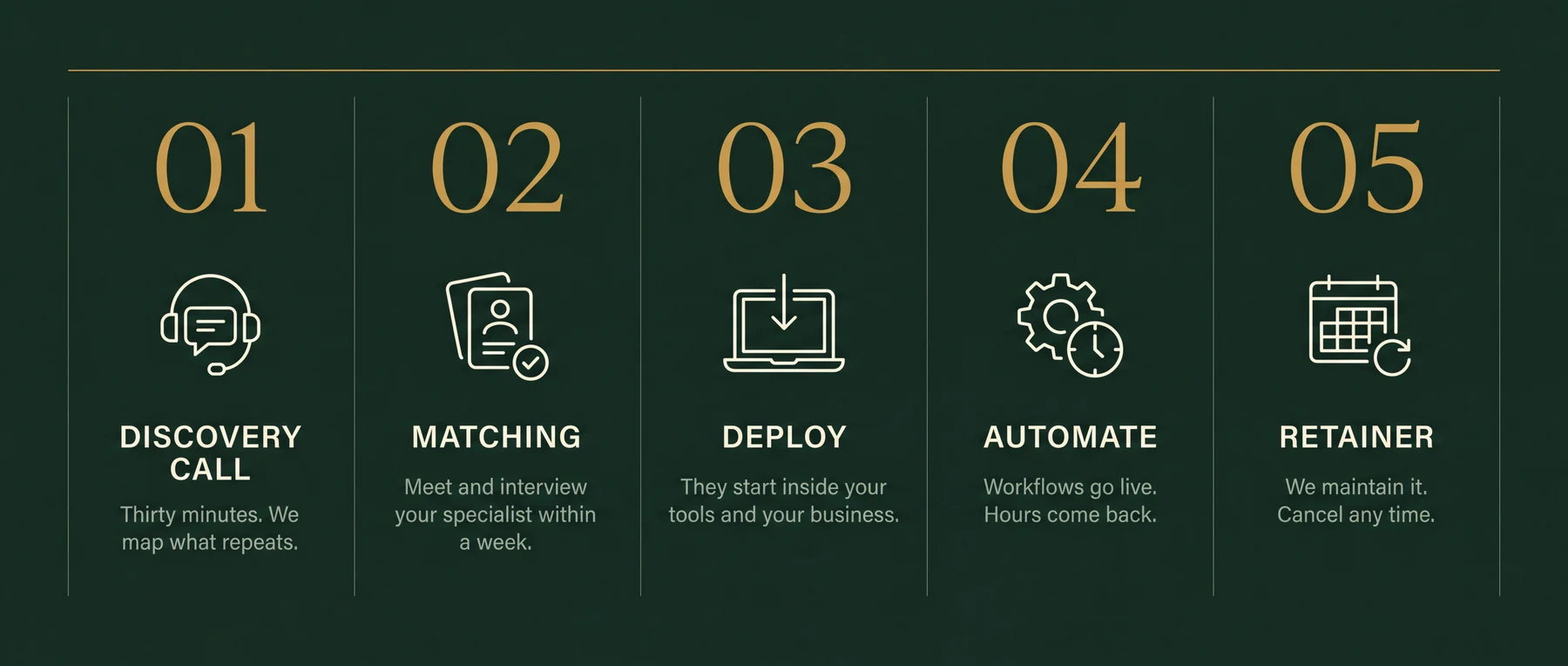
No setup fee. No contract. Stop whenever you want.
Never scoped, never billed per project. The backlog just keeps moving.
Everything is built in your own tools. Cancel and it all keeps running.
A short Friday note on what was automated this week and the hours it saves you.
Academy-trained, background-checked, least-access credentials.
| Delegated AI specialist | Freelance consultant | Automation agency | Doing it in-house | |
|---|---|---|---|---|
| What you pay | One flat monthly rate for 20 hours a week | $75 to $150 an hour | A project fee, then a retainer | A coordinator salary, or your recruiters' evenings |
| Knows staffing workflows | Placed from agency operations and high-volume scheduling backgrounds | Depends entirely who you get | Sometimes, on the senior accounts | You do |
| First workflow live | Week one | After scoping and a signed statement of work | After discovery and onboarding | Between client calls, eventually |
| Works in your ATS | Bullhorn, JobAdder, or whatever you run | If they have used it before | Often only their supported stack | Yes |
| Handles timesheet and payroll reminders | Automated Monday sequences for every contract worker on your books | Custom build at hourly rate | Depends on their scope | Manual, one text at a time |
| If you stop | Every workflow keeps running in your accounts | You inherit whatever is documented | Access can end with the contract | Nothing changes |
The consultant and agency columns describe how those engagements are usually structured, not any one firm. Your own quote is confirmed on the intro call.
Your specialist comes AI-trained and fully fluent in:
 LinkedIn
 Google Sheets
 Zapier
 Claude
 n8n
n8n Twilio
 DocuSign
 Airtable
 Slack
Slack Gmail
Gmail Notion
 Google Calendar
Thursday 9:04 AM
Monday 8:47 AM
Wednesday 3:12 PM
We had forty applicants sitting untouched in Bullhorn because nobody had time to screen them. By the end of week one the qualification texts were going out automatically and candidates were booking their own screens. Our recruiters started the week with a shortlist instead of a pile.
 Rachel T.Owner, regional staffing agencyVerified client
Monday mornings used to mean an hour of chasing timesheets before payroll could run. The reminders go out automatically now, and if someone does not respond, the recruiter gets flagged rather than having to check every single worker. It was the first thing we built and it paid for itself immediately.
 Greg M.Operations Director, temp staffing agencyVerified client
Month-to-month, cancel whenever you want. If your specialist is not the right fit, we replace them free. And every workflow lives in your own accounts, so it stays yours either way.
5
Every specialist is matched by hand to your stack, your tools and your timezone, which caps how many businesses we can start properly. When this month is full, the next start date is the following month.
One flat fee.
Your dedicated AI Automation Specialist for Staffing Agencies, 20 hours a week.
Month-to-month. No setup fee. Cancel anytime and keep every workflow.
Thirty minutes. Bring your messiest week. You leave with the three workflows worth automating first, sequenced and yours to keep. If we're a fit, your specialist starts within a week.
Candidate screening sequences, interview scheduling via Calendly, timesheet reminders for contract workers, weekly client status updates on open orders, redeployment outreach to workers approaching end of assignment, offer letter dispatch via DocuSign, and ATS record hygiene in Bullhorn or JobAdder. The intro call identifies which is costing the most time first.
Yes. Your specialist connects Bullhorn's candidate, job, and placement data to outbound sequences via Zapier or n8n. Application status changes trigger qualification texts, confirmed interviews push back into Bullhorn, and weekly job order summaries pull from live data so recruiters never write a status email by hand.
Yes. JobAdder's API and Zapier integrations let your specialist wire candidate stage changes into automated follow-up, scheduling links, and client updates without you changing your ATS.
Yes. Claude reads the resume against the job requirements, sends a short qualification text, and only passes candidates who meet the basics to a human screen. Unqualified applicants get a polite automated decline. Recruiters start with a shortlist rather than a raw inbox.
Yes. A Monday morning sequence texts every contract worker whose timesheet has not been submitted. A second message goes out at noon if there is still no submission, and the recruiter gets a flagged exception list for anyone who has not responded by end of day. Most payroll delays are eliminated without a single manual call.
Yes. A weekly digest pulls current submission counts, interview stages, and fill status from Bullhorn for each client and sends it on a schedule. Clients stay informed without calling to ask, and recruiters do not write the same update email ten times a week.
Yes. A trigger fires a set number of days before a contract worker's end date, asking whether they are open to a new assignment. Workers who respond as available are flagged for the recruiter to match. Workers who do not respond receive one follow-up. Redeployment rates improve because the outreach actually happens.
The first workflow typically runs in week one. The intro call identifies the highest-cost problem, usually candidate screening lag or timesheet chasing, and that ships first while the next is scoped.
No. Automations run inside your existing ATS and communication tools. Recruiters continue working in Bullhorn or JobAdder the same way they always have. The specialist adds the automation layer around what is already there.
Thirty minutes on your messiest week. The three workflows worth automating first are yours to keep either way.