
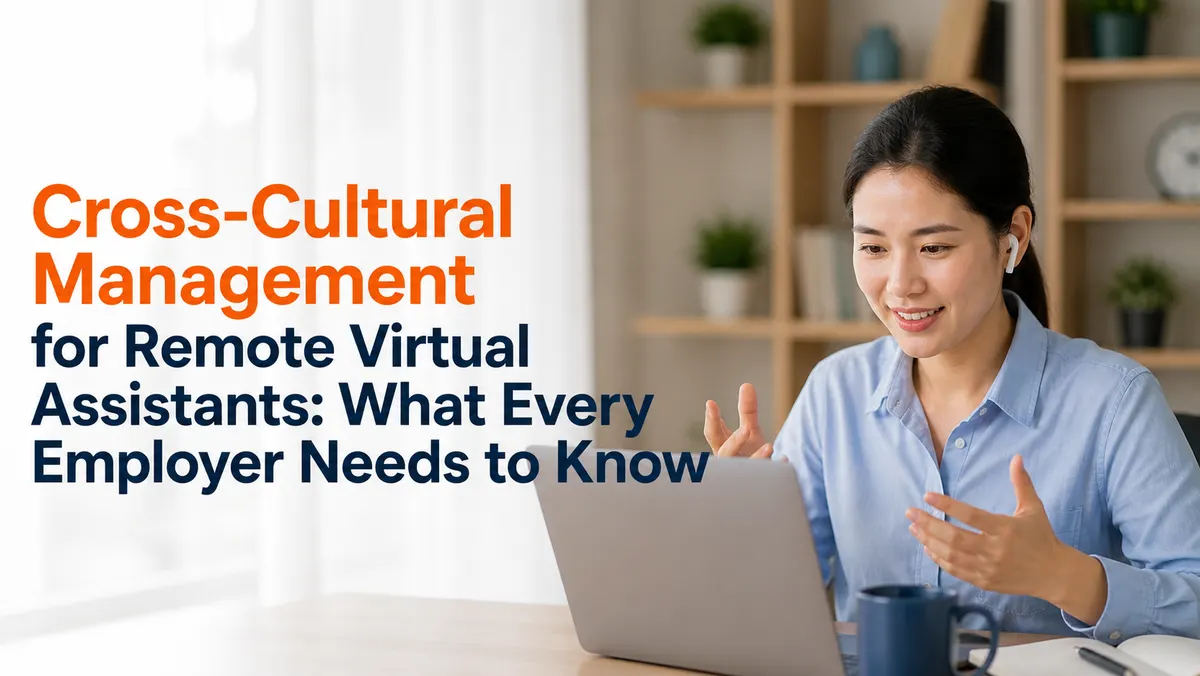
The global remote hiring boom has opened doors that didn't exist a decade ago. Today, a small business in Texas can hire a brilliant virtual assistant from Nairobi. A startup in London can bring on a Remote Digital Marketing Manager from Manila. A consulting firm in Toronto can build an entire support team across five countries without a single shared office.
The opportunity is real. But so is the complexity.
When you hire across borders, you're not just hiring across time zones — you're hiring across cultures. And culture shapes everything: how people communicate, how they handle conflict, how they interpret feedback, how they define professionalism, and how much they're willing to push back on a decision they disagree with.
Cross-cultural management for remote virtual assistants is one of the most underestimated skills in the modern remote work playbook. Companies that get it right build loyal, high-performing distributed teams. Companies that ignore it cycle through hires, misread talent, and wonder why their remote team never quite clicks.
Here's what the conversation should actually look like — and why it matters just as much when you're hiring a Remote Digital Marketing Manager as it does when you're onboarding any virtual assistant.
Why Culture Is a Management Issue, Not Just a Communication Issue
Most employers approach cultural differences as a language problem. They assume that if a remote hire speaks fluent English and uses Slack competently, the cultural layer is handled.
It isn't.
Culture governs behavior at a much deeper level than language. It shapes whether someone will tell you a deadline is unrealistic before it's missed, or stay silent and scramble. It shapes whether "yes" in a meeting means genuine agreement or polite acknowledgment. It shapes how someone responds to public praise versus private feedback, and whether they expect explicit direction or prefer to exercise autonomous judgment.
A Remote Digital Marketing Manager hired from the Philippines, for example, may come from a high-context, high-deference culture where direct disagreement with a manager is considered disrespectful. Without cultural awareness on the employer's part, that same manager will mistake silence for alignment — and discover the misalignment only when a campaign goes sideways.
A virtual assistant hired from Germany, conversely, may communicate with a directness that reads as blunt or aggressive to employers from more relationship-oriented cultures. That directness is professionalism in their cultural framework. Misread it as attitude and you'll lose a great hire over a misunderstanding.
According to Hofstede Insights' cultural dimension research, six measurable cultural dimensions — including power distance, individualism, and uncertainty avoidance — consistently predict workplace behavior across nationalities. Understanding where your hire sits on these dimensions isn't academic. It's practical management.
Power Distance: The Silent Killer of Remote Team Performance
Of all the cultural dimensions relevant to cross-cultural management for remote virtual assistants, power distance is the one most likely to quietly undermine your team.
Power distance refers to the degree to which people in a society accept and expect that power is distributed unequally. In high power distance cultures — common across much of Southeast Asia, Latin America, and parts of the Middle East — employees naturally defer to authority. They follow instructions without questioning them. They avoid raising concerns that might embarrass or challenge a manager.
For a Remote Digital Marketing Manager operating in this cultural context, this creates a specific dynamic: they may execute exactly what you tell them, even when they can see it won't work. Not out of incompetence — out of cultural conditioning that says challenging the boss is inappropriate.
The solution isn't to hire differently. It's to manage differently. Create explicit, structured space for pushback. Ask directly: "What concerns do you have about this plan?" Make it clear — in words, not just implication — that disagreement is not just tolerated but valued. Then respond to pushback without defensiveness when it comes.
This kind of psychological safety doesn't happen by accident in cross-cultural remote teams. It has to be built deliberately and reinforced consistently.
Feedback Across Cultures: What "Constructive" Really Means
Feedback is where cross-cultural misunderstandings cause the most lasting damage — because both parties usually believe they handled it correctly.
In the United States and much of Western Europe, "constructive feedback" typically means direct, specific, and separated from personal relationship. You critique the work, not the person. You say what went wrong and what to do differently. Clarity is kindness.
In many Asian and Middle Eastern cultures, this same directness — especially delivered in writing, especially in front of others — is experienced as a public shaming. The damage isn't to the work relationship. It's to the person's dignity and sense of face.
A Remote Digital Marketing Manager receiving blunt written feedback on a campaign they worked hard on may not respond with the resilience you'd expect from a local hire who grew up in a feedback-heavy professional culture. They may go quiet. They may over-correct anxiously. They may lose confidence in ways that affect their output for weeks.
None of this signals weakness. It signals a cultural mismatch in how feedback is being delivered.
The adjustment isn't complicated: lead with acknowledgment before critique, deliver sensitive feedback privately rather than in group channels, and follow critique with a clear, collaborative path forward. These adjustments cost nothing and protect the working relationship across cultural lines.
Harvard Business Review's cross-cultural management research documents extensively how feedback delivery styles must adapt across cultural contexts — essential reading for any employer managing a distributed remote team.
Time, Deadlines, and the Meaning of "Urgent"
If you've ever had a remote hire submit work "on time" by their definition and late by yours, you've encountered one of the most common friction points in cross-cultural management for remote virtual assistants: the cultural relationship with time.
Monochronic cultures — dominant in Germany, Switzerland, Scandinavia, and much of North America — treat time as linear, segmented, and binding. A deadline is a deadline. Punctuality is respect. Being late is a moral failure.
Polychronic cultures — common across Latin America, the Middle East, much of Africa, and parts of Southeast Asia — treat time as fluid and relational. Relationships and context take priority over rigid schedules. A deadline is a target, subject to adjustment if circumstances shift.
Neither is wrong. Both are cultural frameworks built over centuries. But when a Remote Digital Marketing Manager from a polychronic background misses a campaign launch date because something "came up," and their employer from a monochronic background experiences that as unprofessional or disrespectful, the relationship deteriorates — not because anyone behaved badly, but because no one translated the cultural expectation clearly enough upfront.
The fix is simple: be explicit. Don't say "get this to me by Friday." Say "I need this in my inbox by Friday at 5 PM your time, no exceptions — if anything blocks that, tell me 48 hours in advance." Remove ambiguity. Build the cultural expectation into the instruction itself.
Building a Cross-Cultural Onboarding System
The most effective employers of remote virtual assistants treat onboarding as a cultural orientation, not just a task handoff. This is especially true when the hire is a Remote Digital Marketing Manager — someone who will be representing your brand voice, making judgment calls about content, and communicating on your behalf with your audience.
A culturally intelligent onboarding process includes:
Explicit communication norms. Document how your team communicates: expected response times, which channels carry which types of messages, how disagreement should be raised, and what "done" means for different deliverables. Don't assume these are obvious — they're not.
Cultural context sharing — in both directions. Share what your company culture values and why. Then ask your new hire about their professional background and working style. Make the conversation bidirectional. You'll learn things that will help you manage them better from day one.
Regular, structured check-ins in the early months. Not micromanagement — but intentional touchpoints where you ask explicitly: "Is anything unclear about how we work? Is there anything I've asked for that felt confusing or contradictory?" These questions invite the kind of feedback that high power distance cultures don't volunteer spontaneously.
According to SHRM's guide on managing global remote teams, companies that invest in structured cultural onboarding see significantly lower turnover in their first-year remote hires — a metric that matters enormously when you've spent time and budget finding the right Remote Digital Marketing Manager for your business.
The Mindset Shift That Changes Everything
Cross-cultural management for remote virtual assistants is not about lowering standards. It's not about excusing poor performance or tolerating missed deadlines indefinitely. It's about understanding that the behaviors you observe in a remote hire are not always what they appear to be through your own cultural lens.
Silence is not always agreement. Directness is not always aggression. Deference is not always incompetence. Flexibility with time is not always laziness.
When you hire a Remote Digital Marketing Manager from a different cultural background, you're not just adding a skill set to your team. You're adding a perspective, a working style, and a set of professional values shaped by an entirely different context than your own. That context, managed well, is a competitive advantage. Managed poorly, it's a source of constant friction that neither side can explain.
The companies winning at remote hiring right now are the ones who've stopped treating culture as a footnote and started treating it as a core management discipline.
That shift — from cultural ignorance to cultural intelligence — is available to any employer willing to make it. And for the teams built on that foundation, the results consistently speak for themselves.
For a practical starting framework, Coursera's cross-cultural management courses offer accessible, evidence-based training for managers building globally distributed remote teams — a worthwhile investment before your next international hire.