Why remote hiring works better than most companies think
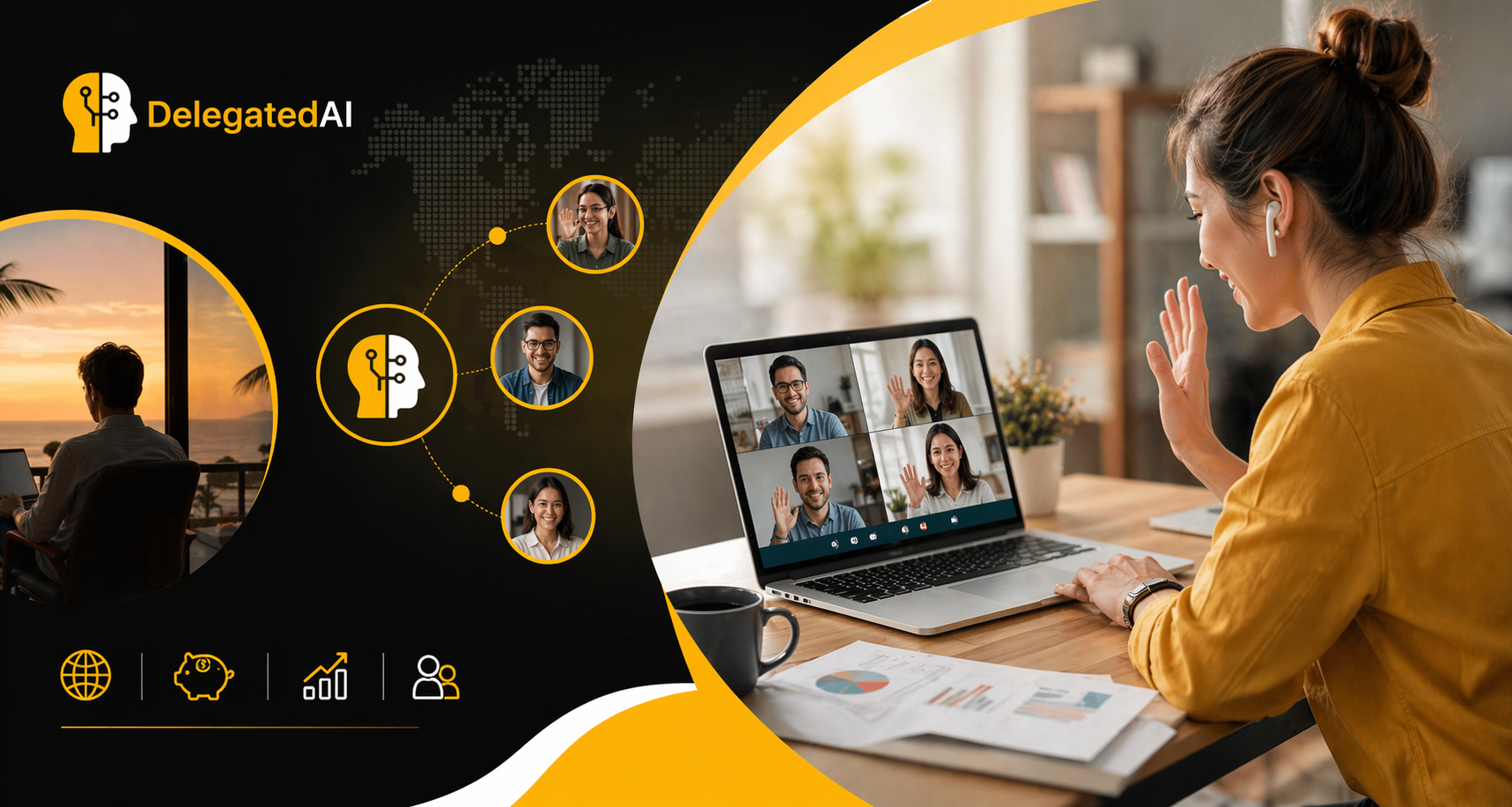
The early skepticism around remote work centered onaccountability, collaboration, and culture. Those concerns haven't disappeared— but they've been substantially addressed by better tooling, clearercommunication frameworks, and a new category of AI-powered support. An AIvirtual assistant can now handle scheduling, first-pass research,documentation, data entry, and client communications on behalf of a remoteemployee, eliminating much of the friction that once made distributed teamsfrustrating to manage.
· 74% of workers say remote roles increaseproductivity
· 3x more applicants for remote jobpostings vs. on-site
· $11k average annual savings per remoteemployee
When you pair a skilled remote hire with an AI virtualassistant, you're compounding these gains. The human brings judgment,creativity, and relationship intelligence. The AI handles repetitive cognitivetasks. Together, they perform at a level that neither could achieve alone.
"The question is no longer whether to hireremotely—it's which roles to prioritize and how to equip them to win."
The top roles to hire remotely right now
Role 01
Executive & Personal Assistant
This is the role that has been most dramatically reshaped byremote work — and by AI. A remote executive assistant backed by an AIvirtual assistant can manage complex calendars, handle email triage,prepare meeting briefs, and coordinate international travel without eversetting foot in a physical office. The combination frees senior leaders fromadministrative drag and gives the assistant leverage that was unimaginable adecade ago.
Role 02
Content Strategist & Copywriter
Writing has always been a solitary pursuit. Remotecopywriters and content strategists consistently outperform their office-basedcounterparts in output volume and quality—largely because they control theirown deep-work environment. Pair a senior content strategist with an AIvirtual assistant for research, outlining, and performance tracking, andyou have a content engine that runs around the clock.
Role 03
Software Engineer & Developer
Engineering was among the first disciplines to go fullyremote—and for good reason. Code is inherently asynchronous. A developer inTallinn and a developer in Toronto can collaborate on the same codebase withzero degradation in output. Modern engineering teams use an AI virtualassistant to automate code review queues, generate documentation, andsurface relevant context from previous sprints, keeping distributed teamstightly aligned without unnecessary meetings.
Role 04
Customer Success Manager
Customer success is a relationship-driven role—but therelationships live in email threads, video calls, and CRM records, not a sharedoffice. A skilled remote CSM can manage a book of 80–120 accounts just aseffectively from home as from a cubicle. An AI virtualassistant amplifies this by drafting renewal communications, flaggingat-risk accounts based on usage data, and preparing customized QBR decksautomatically.
Role 05
Data Analyst & Business Intelligence Specialist
Data work is highly asynchronous and deeply individual.Analysts spend most of their time inside spreadsheets, SQL editors, and BIplatforms — none of which require physical presence. An AI virtualassistant can handle routine reporting, anomaly flagging, and datacleaning, allowing remote analysts to dedicate their cognitive energy tointerpretation and strategic recommendation rather than data wrangling.
Role 06
Digital Marketer & Performance Specialist
Digital marketing is arguably the most location-independentdiscipline in business. Campaigns run in dashboards. Creative is reviewed inshared docs. Performance data is accessible from anywhere. Remote digitalmarketers — especially those supported by an AI virtual assistant forA/B test analysis, ad copy generation, and competitor monitoring — oftenoutperform in-office teams simply because they spend less time in unproductivemeetings and more time executing.
Makingthe remote hire last: the infrastructure question
Hiring remotely is the easy part. Retaining and acceleratingremote talent is the harder challenge. The companies that do it best share acommon trait: they invest in operational infrastructure before headcount. Thismeans clearly documented processes, async-first communication norms, and —increasingly — an AI virtual assistant embedded into each role'sworkflow from day one.
Think of the AI virtual assistant not as ashortcut but as a force multiplier. When your remote content strategist doesn'thave to manually research competitor posts, your remote customer successmanager doesn't have to format every renewal deck by hand, and your remoteexecutive assistant doesn't have to hunt through inboxes for meeting context,every hour saved compounds into measurable business impact.
The hiring criteria that matter most
When evaluating remote candidates for any of the rolesabove, the characteristics that predict success look slightly different fromin-office hiring. Prioritize self-direction, written communication fluency, anddemonstrated comfort with async workflows. Ask candidates how they have alreadyintegrated an AI virtual assistant into their own productivity system— it's a telling signal of both technical adaptability and professionalseriousness.
Remote work rewards people who take ownership. The bestremote hires don't wait for someone to tap them on the shoulder. They buildsystems, document their reasoning, and use every available tool — includingan AI virtual assistant — to stay ahead of their workload.
Final word
The remote revolution is not coming. It arrived. Thecompanies winning the talent game right now are the ones that have stoppedasking whether remote hiring is viable and started asking which roles toprioritize—and how to equip those people with the tools, autonomy, andintelligent support they need to do exceptional work. An AI virtualassistant is no longer a luxury feature. For remote teams, it is becomingas essential as a stable internet connection.
Invest in the right roles. Build the right systems. And giveyour remote workforce the AI-powered support they need to make distributed worktheir greatest competitive edge.