
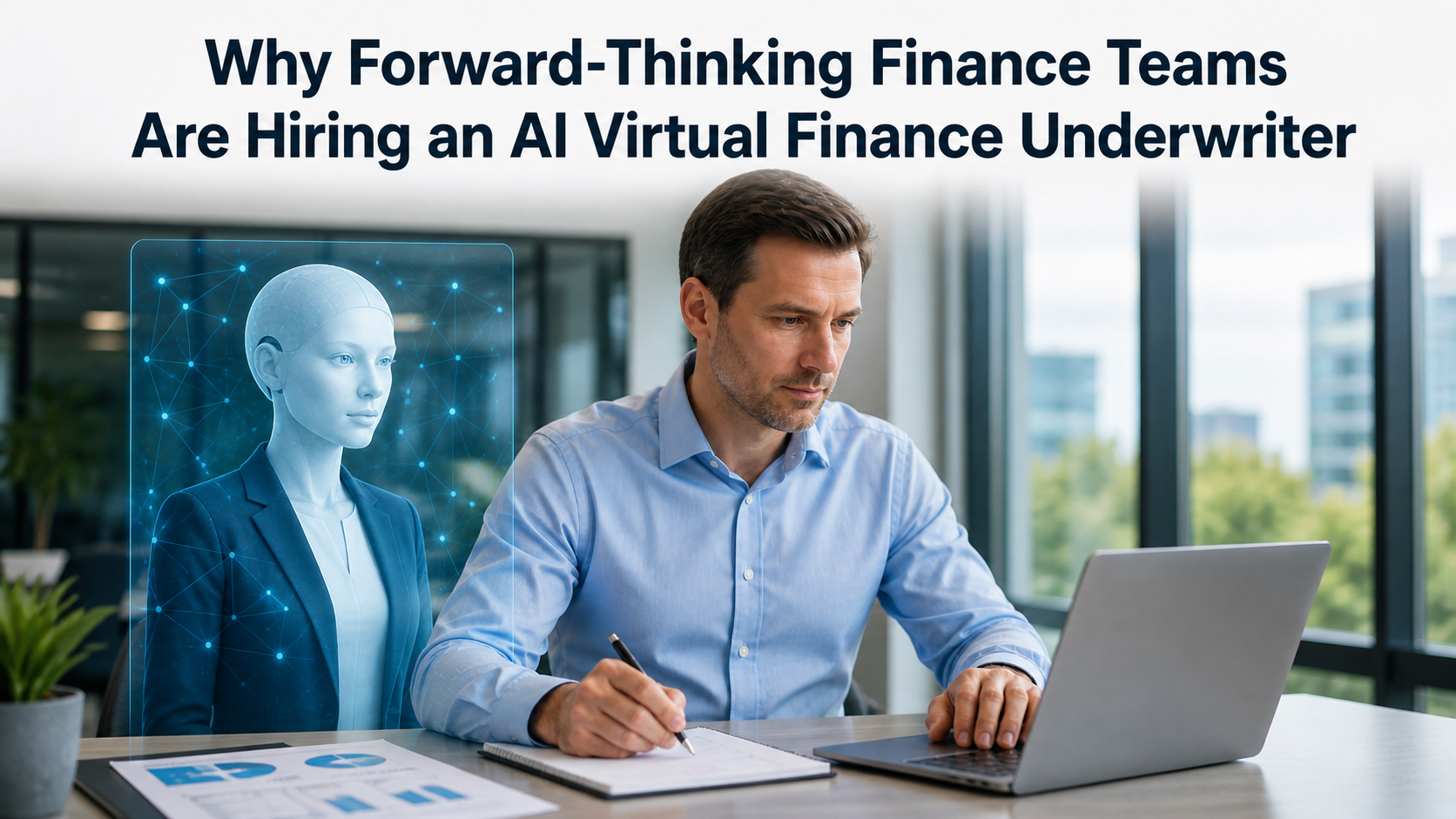
Why Forward-Thinking Finance Teams Are Hiring an AI Virtual Finance Underwriter
The financial services industry is undergoing one of themost significant structural transformations in its modern history. Advances inAI-powered analysis tools, the widespread normalization of high-performanceremote work, and relentless pressure on operating margins across lending,insurance, and investment sectors are driving organisations of every scale tofundamentally reconsider how — and where — their underwriting functionoperates. For businesses that have historically relied on centralised, in-officeunderwriting teams, the realisation that skilled, analytically rigorous, andfully compliant underwriting professionals can deliver exceptional results fromanywhere in the world represents both a meaningful cost opportunity and agenuine competitive repositioning.
Hiring an AI virtual finance underwriter is at thecentre of this shift. By combining deep sector-specific financial expertisewith AI-powered risk analysis tools, a skilled virtual underwriter can deliver remoteunderwriting services that match or materially exceed the output quality ofa traditional in-house hire — at a fraction of the total employment cost, andwith the flexibility to scale in line with application volume rather than fixedheadcount. This guide covers exactly what to look for, how to structure thehiring process, how to onboard for compliance, and how to manage this criticalfunction effectively in a remote-first environment.
What an AI Virtual Finance Underwriter Actually Does
An AI virtual finance underwriter performs the samefoundational function as a traditional underwriter — evaluating risk exposure,assessing applications against established criteria, determining coverage orloan eligibility, and producing structured, well-documented recommendations — butdoes so remotely, leveraging AI-powered tools that accelerate the analyticalprocess and reduce the margin for human error across complex and high-stakesfinancial decisions.
The scope of remote underwriting services variesmeaningfully depending on the sector in which the role operates. In insurance,it means evaluating policy applications against actuarial risk models andregulatory guidelines. In mortgage and commercial lending, it means assessingborrower profiles, credit histories, collateral valuations, and debt-to-incomeratios against lender criteria and secondary market requirements. In investmentand specialty finance, it means performing due diligence reviews, covenantanalysis, and risk-adjusted return assessments across deal structures.Regardless of the vertical, the role demands analytical precision, a thoroughunderstanding of the regulatory environment, and the ability to produce clearand defensible written recommendations that stand up to scrutiny fromcompliance teams, senior credit committees, clients, and external regulatorsalike.
How AI Transforms the Capability of a Virtual Underwriter
The integration of AI into financial analysis workflows hasfundamentally expanded what a single qualified underwriter can evaluate,process, and document within a standard working week. An AI virtual financeunderwriter operating with machine learning-assisted risk assessmentplatforms, automated document parsing and extraction tools, and AI-poweredcredit analysis software can process significantly higher application volumes —with greater consistency, auditability, and documented reasoning — than a manualunderwriter working on traditional systems and processes.
This capability expansion is directly reflected in thequality and throughput of remote underwriting services that businessescan access today at competitive price points. AI tools do not replaceunderwriting judgment — they accelerate the data-gathering, patternrecognition, and documentation components of the workflow, freeing the humanprofessional to focus on nuanced risk interpretation, exception handling, andthe contextual decision-making that automated systems cannot crediblyreplicate. According to Investopedia,the fundamental purpose of underwriting remains the evaluation and accuratepricing of risk — AI enables that function to operate at scale, with greaterspeed and measurably lower processing cost per application.
Industries and Business Types That Benefit Most
The business case for hiring an AI virtual financeunderwriter applies most directly and compellingly to organisations whereunderwriting demand is significant, consistent, and growing — but where thecost of maintaining a full in-house underwriting team creates either marginpressure or headcount constraints that limit the function's capacity.
Insurance carriers, mortgage lenders, fintech lendingplatforms, equipment finance companies, commercial real estate investmentfirms, trade finance operations, and specialty lending businesses are among thesectors deriving the greatest measurable value from remote underwritingservices. Smaller brokerages, independent lenders, and emerging fintechoperations that cannot financially justify a full-time in-house underwriterbenefit in particular — gaining access to senior-level analytical capabilityand sector experience on terms that would be financially prohibitive through atraditional employment arrangement. The structural ability to scaleunderwriting capacity directly in line with application volume — withoutcommitting to fixed headcount costs during quieter periods — is itself asignificant operational and financial advantage that compounds over time.
What to Look for When Hiring: Non-Negotiable Criteria
Defining the right candidate profile for an AI virtualfinance underwriter role demands considerably more precision than mostremote hiring processes — because the consequences of an underwriting error arefinancial, regulatory, and reputational simultaneously, and often difficult toreverse once a decision has been actioned. Every candidate must bringverifiable technical expertise specific to your business context, notgeneralised financial literacy or adjacent experience.
The non-negotiable criteria to assess rigorously include:sector-specific underwriting experience directly relevant to your product typeand regulatory environment, demonstrated hands-on proficiency with AI-assistedunderwriting platforms and risk analysis tools, a thorough and currentunderstanding of the regulatory framework governing your jurisdiction, strongwritten communication capability for producing clear and fully defensibledecision documentation, and a measurable track record of accurate risk assessmentevidenced by claims performance data, loan default rates, compliance auditrecords, or credible references from senior credit or risk leadership. Quality remoteunderwriting services depend entirely on the professional foundation of theperson delivering them — credentials, depth of experience, and verifiableperformance history should be treated as non-negotiable prerequisites, notdesirable attributes.
The Hiring Process: Screening, Assessment, and Paid Trial
Hiring an AI virtual finance underwriter requires astructured, multi-stage evaluation process that goes decisively beyond resumereview and a general competency interview. Begin with a credential andregulatory licence verification step — confirming that the candidate holds thecertifications, accreditations, and any mandatory registrations appropriate toyour jurisdiction and product category. Follow with a structured technicalinterview built around sector-specific scenario questions designed to test regulatoryknowledge depth, risk identification logic, and the quality of decisionreasoning.
According to LinkedIn Talent Solutionsresearch, structured technical assessments significantly outperformunstructured interview conversations at predicting real-world performance inspecialist financial roles — precisely because the depth of technical knowledgerequired cannot be adequately revealed through general questions andconversational chemistry. Assign a paid technical assessment that presents arealistic underwriting case study with defined source documents, a clear outputformat, and a time boundary that mirrors working conditions. The accuracy,reasoning quality, and documentation standard of what the candidate producesreveals everything about the remote underwriting services they willdeliver — before a single offer has been made.
Onboarding for Compliance, Data Security, and Regulatory Alignment
Onboarding an AI virtual finance underwriter into aremote working arrangement demands a level of compliance rigour and datasecurity discipline that goes substantially beyond standard remote roleonboarding. Underwriters routinely work with sensitive personal financial data,regulated loan and policy documents, proprietary risk models, and commerciallysensitive deal information — and every aspect of how that data is accessed,processed, stored, transmitted, and ultimately destroyed must be explicitlydefined and enforced before the professional begins any substantive work.
Establish clear data handling protocols aligned with allapplicable regulations — GDPR, GLBA, FCRA, or relevant state andjurisdiction-specific equivalents depending on your operating environment andproduct type. Provide system access through secured, fully documented channelswith role-appropriate permission levels that are reviewed and confirmed by yourcompliance or IT security function. Define the scope of remote underwritingservices in a written service agreement that explicitly coversconfidentiality obligations, data protection responsibilities, regulatoryreporting requirements, escalation protocols for complex decisions, and thespecific consequences of non-compliance. According to the Insurance Information Institute, data integrityand regulatory compliance are not supporting elements of professionalunderwriting — they are its foundational operating requirements, remote orotherwise.
Managing Performance and Measuring Output Quality Over Time
A high-performing AI virtual finance underwritershould operate within a clearly defined and actively maintained performancemeasurement framework from their very first week in the role — not introducedafter problems emerge. Core metrics to establish, track, and review regularlyinclude: application processing volume and turnaround time against agreedservice levels, decision accuracy rates measured against subsequent claimsexperience or loan performance data, compliance adherence rates across allregulatory documentation and reporting requirements, decision documentationcompleteness and quality scores assessed through periodic file review, andexception escalation frequency as an indicator of appropriate professionaljudgment.
Remote underwriting services that are notsystematically measured against defined standards drift toward inconsistencyand quality degradation over time — even with highly capable professionals whoare genuinely committed to delivering strong work. According to Forbes, high-performing remote professionalsin specialist financial roles share one structural characteristic acrossvirtually every documented case: clear, documented output standards enforcedthrough regular performance reviews and accountability frameworks that do notdepend on physical co-location to function effectively.
The Strategic Case for Building Remote Underwriting Capability Now
The decision to hire an AI virtual finance underwriteris no longer niche, experimental, or reserved for technology-forwardorganisations operating at the frontier of financial services innovation. It isan increasingly mainstream strategic decision being made by insurers, lenders,fintech platforms, and commercial finance businesses that recognise thepractical, financial, and operational advantages of accessing seniorunderwriting expertise through a remote, AI-enhanced model that scales withdemand.
Remote underwriting services delivered by awell-hired, thoroughly onboarded, and consistently managed virtual professionalmatch the quality, compliance standard, and decision consistency of traditionalin-house underwriting — at a cost structure that preserves margin, eliminates fixedheadcount risk, and adapts flexibly to changing application volumes acrossbusiness cycles.
The financial services landscape rewards precision, speed,and disciplined risk management above almost every other operational quality. Askilled AI virtual finance underwriter brings all three — and thebusinesses that build their underwriting capacity around this model today willhold a structural efficiency and cost advantage that compounds across everyapplication cycle, every risk decision, and every client relationship their remoteunderwriting services support, protect, and ultimately define.