
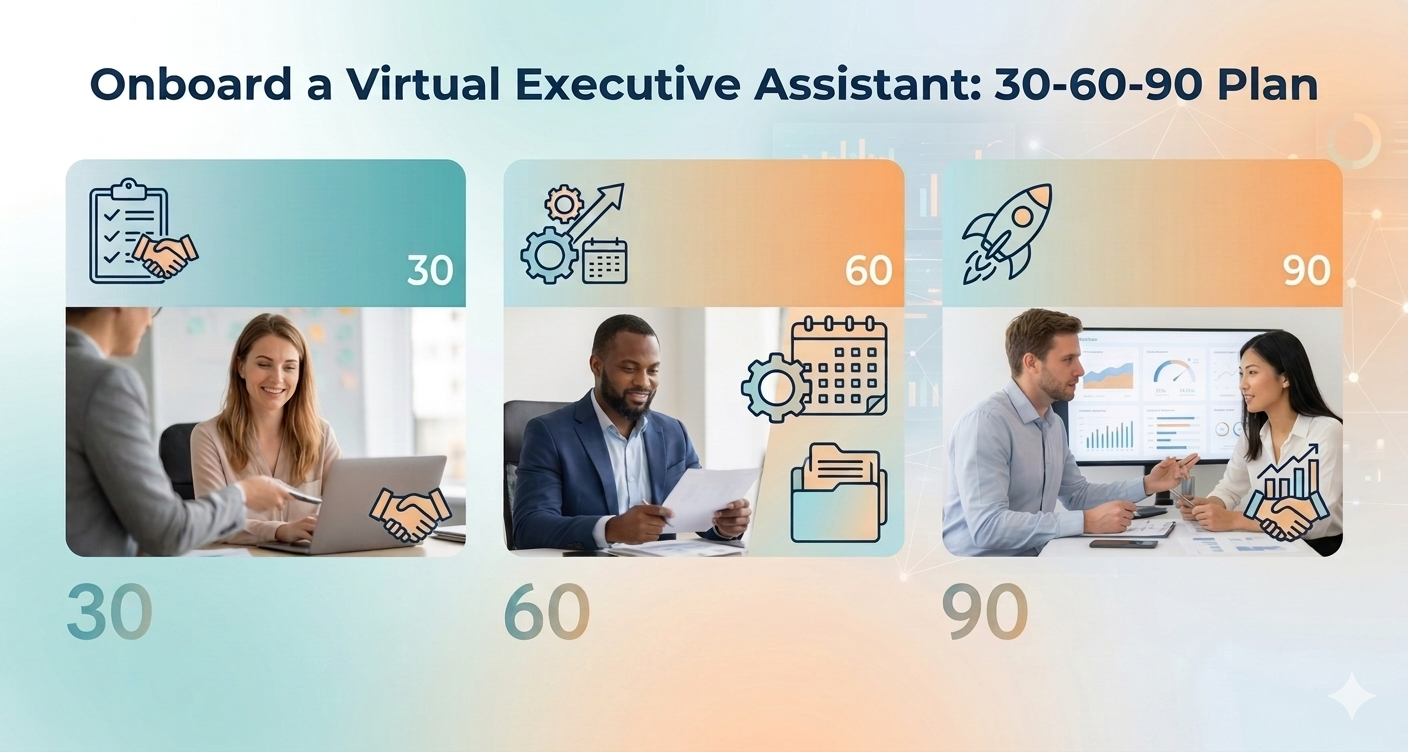
How to Onboard a Virtual Executive Assistant: A 30-60-90 Day Plan for Maximum Productivity
Hiring the right person to support a senior leader orexecutive team is one of the most consequential talent decisions a business canmake. An executive virtual assistant operates at the preciseintersection of strategy and execution — managing calendars, communications,travel, projects, and priorities that directly shape how a leader performs andhow the broader organization functions. Get this hire right, and the executive gains meaningful hours back every single week. Get it wrong, and theconsequences radiate across the entire business in ways that are difficult tocontain and expensive to reverse.
Today, the most capable candidates for this role combinetraditional executive support expertise with genuine proficiency in theAI-powered tools that are reshaping how remote administrative work gets done.An AI Remote Virtual Assistant brings not just organizational skill, butthe technological fluency to automate, streamline, and meaningfully elevate thestandard of support they deliver. This guide gives you the specific interviewquestions — and the reasoning behind each — to identify exactly that quality ofcandidate before you make your hiring decision.
Why the Interview Process Matters More for Remote Executive Roles
The stakes of an executive support interview are uniquely high, and the margin for error is narrow. Unlike many roles where a trialperiod can surface misalignment gradually before significant damage occurs, an executivevirtual assistant who lacks the right combination of skill, judgement, andwork ethic affects the productivity of your most senior leaders from their veryfirst week in the role.
Remote hiring adds a layer of complexity that demands a more rigorous interview structure: you cannot observe body language in a traditional context, assess how a candidate navigates interpersonal dynamics naturally, or rely on the informal observations that a shared workspace produces over time. A well-designed interview process — built specifically for an AI Remote Virtual Assistant role — compensates for these limitations by creatingstructured situations that reveal how candidates think, communicate, prioritize,and perform under realistic pressure. The quality of your questions determinesthe quality of the information you have when making one of your most sensitiveand high-stakes hiring decisions.
Questions to Assess Technical and AI Tool Proficiency
The modern executive virtual assistant role is inseparable from technology. Calendar coordination, inbox management, travel logistics, document preparation, and project tracking all increasingly rely on AI-powered platforms and productivity tools that the strongest candidates use fluently — not just occasionally. A skilled AI Remote Virtual Assistant should demonstrate command of these tools, not just awareness of them.
Ask these directly:
- "Which AI tools or productivity platforms do you use most consistently in your daily work, and how specifically do they improve your output?"
- "Walk me through how you would use AI tools to manage, prioritize, and respond to a high-volume executive inbox."
- "How do you actively stay current with new platforms relevant to remote executive support?"
Strong candidates will reference specific tools — such as ChatGPT for drafting, Notion AI for documentation, Zapier for workflow automation, or Google Workspace for collaboration — with concrete examples of how each has been applied to real executive support challenges.
Questions to Evaluate Communication and Responsiveness
An AI Remote Virtual Assistant supporting anexecutive operates in a high-stakes communication environment where the tone of an email, the timing of a response, or the precision of a single message cancarry meaningful consequences for client relationships, internal team dynamics,and leadership credibility. Communication quality in this role is not optional— it is foundational.
According to SHRM's guidance on behavioral interviewing, asking candidates to describe specific past behaviours is significantly more predictive of future performance thanhypothetical or abstract questions. Apply that principle here:
- "Tell me about a time you managed a difficult or sensitive communication on behalf of an executive. How did you approach it and what was the outcome?"
- "How do you ensure your written communication remains clear, professional, and appropriately toned when working asynchronously across different time zones?"
- "Describe a situation where a miscommunication created a problem. What caused it, and what did you change afterward?"
Strong executive virtual assistant candidates givestructured, specific answers that demonstrate both consistent discretion andthe confidence to take appropriate initiative.
Questions to Test Organisational and Priority Management
An executive's time is their most valuable and most finiteresource. The core function of an executive virtual assistant isprotecting and optimizing that resource with disciplined intelligence.Interview questions in this area should reveal whether the candidate thinksstrategically about priorities — or simply manages a task list reactively.
- "How do you manage competing urgent requests from multiple stakeholders when your executive's calendar is already at full capacity?"
- "Describe the system you use for tracking outstanding tasks, deadlines, and follow-ups across multiple simultaneous projects."
- "What is your process when a high-priority deliverable arrives while you are already midway through another time-sensitive task?"
Harvard Business Review research clearly demonstrates that the most effective executive assistants operate asgenuine strategic partners rather than task-executors. A strong AI RemoteVirtual Assistant candidate will describe specific, documented systems andframeworks — not just good intentions — that they apply consistently to managecomplexity.
Questions to Assess Confidentiality and Professional Judgement
An AI Remote Virtual Assistant working at theexecutive level handles sensitive information as a matter of routine —financial data, personnel matters, strategic plans, board communications, andprivate correspondence. The capacity to exercise sound professional judgementand maintain absolute discretion is not a desirable quality in this role. It isa non-negotiable baseline.
Ask these without softening them:
- "Can you describe a situation where you were trusted with highly confidential or commercially sensitive information? How did you manage that responsibility?"
- "What is your personal approach to handling information you know carries significant sensitivity or legal implications?"
- "How would you respond if a colleague - even a senior one - asked you to share details about an executive's schedule, private decisions, or personal communications?"
A genuinely qualified executive virtual assistantanswers these questions without hesitation and with principled specificity —demonstrating an internalized professional ethic rather than a rehearsed answerdesigned to satisfy the interviewer.
Questions to Gauge Proactivity and Problem-SolvingInstinct
The defining difference between a capable and an exceptionalexecutive virtual assistant is proactivity. A reactive assistant waitsfor detailed instructions before every action. A truly outstanding AI RemoteVirtual Assistant anticipates needs, identifies problems before they become crises, and takes intelligent, well-bounded initiative that consistently makestheir executive's life easier — not more complicated.
Surface this quality with:
- "Tell me about a time you identified a significant problem your executive was unaware of and resolved it proactively before it escalated."
- "How do you move from responding to requests toward anticipating what your executive will need next?"
- "Describe a situation where you had to make a consequential judgment call without being able to reach your executive. What did you decide and how did you reach that decision?"
LinkedIn Talent Solutions research confirms that proactivity ranks consistentlyamong the top traits hiring managers actively seek in executive supportcandidates — and among the traits most frequently underscreened for in poorlystructured interviews.
Scenario-Based Questions That Reveal Real Thinking
Scenario-based questions are among the most revealinginstruments available in an executive support interview. They remove thepossibility of a polished theoretical answer and require candidates todemonstrate genuine thinking in real time, under mild pressure — which isprecisely the condition they will face daily in the role. For an AI RemoteVirtual Assistant position, practical scenarios should reflect the actualcomplexity and stakes of executive-level support work.
Use these:
- "Your executive has back-to-back meetings for the next two days and a Board presentation due in 24 hours. How do you manage this situation?"
- "You discover a double-booking conflict at 7 AM on the morning of a critical client meeting. Walk me through exactly what you do."
- "You receive an urgent change to travel arrangements while your executive is mid-flight and unreachable. What actions do you take and in what order?"
According to Glassdoor's hiring research, candidates who respond to scenario questions withstructured, methodical thinking — rather than general reassurances —consistently outperform those who rely on confidence and charm during the executivevirtual assistant evaluation process.
Red Flags That Should Stop the Process
Knowing what a poor answer looks like is just as importantas knowing the right questions to ask. When interviewing for an AI RemoteVirtual Assistant role at the executive level, treat the following asserious warning signals that warrant pausing or ending the process: inabilityto provide specific, concrete examples from genuine past experience; vagueclaims about "working well under pressure" without evidence tosupport them; unfamiliarity with AI tools combined with indifference tolearning them; inability to clearly articulate a system for managing competingpriorities; and evasive or formulaic responses to confidentiality questions.
An executive virtual assistant who cannot describe inprecise, specific terms how they have handled genuinely challenging real-worldsituations is unlikely to perform differently in your organization. Specificity— in every answer, at every stage — is the most reliable signal of authentic,tested experience.
Hire With Confidence, Lead With Focus
Interviewing for an AI Remote Virtual Assistant atthe executive level demands a structured, deliberate, and rigorous process —because the cost of getting this particular hire wrong falls directly on yourmost senior leaders and their capacity to perform at their highest level. Thequestions in this guide are designed to cut through polished surface answersand surface the genuine capability, professional judgement, and technologicalfluency that defines the modern executive virtual assistant.
Use this framework as your foundation, adapt each questionto your executive's specific working style and organizational context, and always close the process with a practical, paid trial task that mirrors realresponsibilities from day one. The right candidate will not merely answer thesequestions well — they will demonstrate, through every interaction across theentire interview process, exactly why they are the right hire for one of themost important roles in your business.